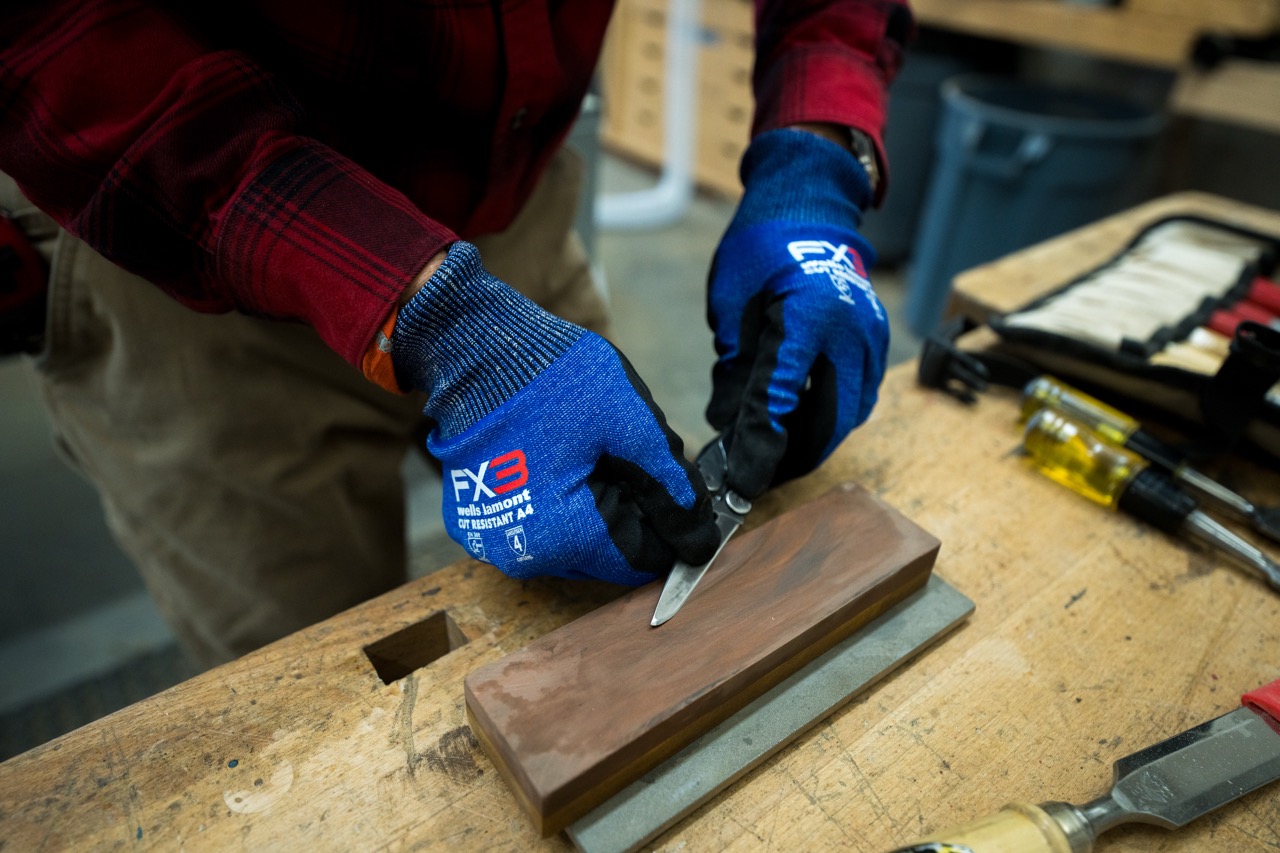
You see an A4 symbol on a glove but have no idea what it means. You’re not the only one. Similar letters and numbers show up on glove spec sheets, product pages, and packaging, yet most people who read them were never handed a decoder.
That’s what this guide is for. Once you understand the scale, matching a glove to your job takes a few minutes instead of a guess.
In the United States, cut protection is classified under ANSI/ISEA 105, now in its 2024 edition, on a scale from A1 to A9. Cross the Atlantic and you’ll run into EN 388, a different system that reports mechanical protection its own way. Here’s how to read both, and how to tell which number actually matters for the work in front of you.
What an ANSI cut rating actually tells you
An ANSI cut rating tells you how much force it took to cut through a glove’s material during a standardized lab test. It doesn’t tell you how that glove will hold up against every blade, edge, or angle you might run into on the job.
The American National Standards Institute (ANSI) doesn’t run the tests itself. ISEA, the International Safety Equipment Association, writes and maintains the standard, and ANSI publishes it as the American National Standard for Hand Protection Classification, currently the 2024 edition.
Here’s the test in plain terms: a machine draws a straight blade across the glove material and keeps adding weight until the blade cuts through. Whatever weight it took, measured in grams-force, sets the level. The 2024 revision also standardized how that result gets printed on the label, a pentagon-shaped mark with the cut level at top, abrasion at left, and puncture at right, so you can read all three at a glance.
One thing the rating won’t do is promise a cut-proof glove. A9 material still cuts. It just takes a lot more force to get there than an A1 does. Treat the number as a way to compare gloves, not a guarantee.
The nine-level scale itself is a fix for an older mess. Before 2016, ANSI used a 0-5 scale that looked a lot like Europe’s EN 388 numbering, and the two got confused constantly, even though they weren’t measuring cut resistance the same way. Expanding to A1 through A9 gave the American standard its own distinct scale, wide enough to separate a light-duty glove from a heavy-industrial one without the two systems overlapping on paper.
The A1 to A9 scale, in plain terms
The nine levels run in order from lightest to heaviest protection. ISEA’s own guidance groups A1 through A3 with lighter hazards, A4 and A5 with medium ones, and A6 through A9 with high cut hazards.
| ANSI Level | Force to Cut Through | Where You’d Typically See It |
| A1 | 200 to 499 gf | Light packaging, cardboard, general handling |
| A2 | 500 to 999 gf | Basic assembly, light warehouse work |
| A3 | 1,000 to 1,499 gf | Parts handling with mildly sharp edges, light construction |
| A4 | 1,500 to 2,199 gf | Drywall, HVAC, electrical work, light glass and metal handling |
| A5 | 2,200 to 2,999 gf | Metal fabrication, appliance assembly, glass handling |
| A6 | 3,000 to 3,999 gf | Sharp metal handling, food processing, recycling |
| A7 | 4,000 to 4,999 gf | Metal stamping, automotive manufacturing |
| A8 | 5,000 to 5,999 gf | Heavy fabrication, glass manufacturing |
| A9 | 6,000+ gf | The most severe cutting hazards ISEA classifies |
Those applications come from ISEA’s own guidance, not a guarantee for your specific task. Two jobs that both sound like “handling metal” can sit at opposite ends of this table depending on the edge, the force behind it, and how long you’re gripping it.
What does A4 cut resistance mean?
A4 means the glove needed at least 1,500 grams of force, and less than 2,200, before a test blade cut through it. That puts it in the range where ISEA’s guidance lists drywall, electrical work, HVAC, and light glass or metal handling. It’s also one of the more common ratings on general-purpose work gloves, since it adds real protection without costing you much feel or flexibility.
EN 388, explained
EN 388 is the European standard for gloves that guard against mechanical risks: cuts, abrasion, tears, and punctures. The current edition is EN 388:2016+A1:2018.
Where ANSI packs everything into one cut rating, EN 388 lists several results in a row, and each test has its own scale: abrasion resistance (0 to 4), an older circular-blade cut test (0 to 5), tear resistance (0 to 4), and puncture resistance (0 to 4), in that order. A 0 means the glove fell below the lowest passing level, and higher is better on every test. SATRA, a PPE testing and certification body, publishes a breakdown of the EN 388 tests.
A newer straight-blade cut test, ISO 13997, adds a letter from A to F after those four numbers when a glove has been tested against it. An optional P at the end shows the glove passed impact testing.
So a marking like 4X42D isn’t one combined score. Read each position on its own: abrasion 4, circular-blade cut not tested, tear 4, puncture 2, and an ISO 13997 cut grade of D. An X in any spot means that property wasn’t tested or doesn’t apply. It says nothing about failure.
ANSI vs. EN 388: not the same scale
ANSI and EN 388 both measure cut resistance, but they aren’t translations of each other. ANSI runs A1 to A9 in grams-force. EN 388’s ISO 13997 letter grade runs A to F in newtons. Both rely on a similar idea, a blade drawn under increasing force, but the equipment, the units, and the thresholds differ.
| ANSI/ISEA 105-2024 | EN 388:2016+A1:2018 | |
| Common market | US and North America | Europe and international |
| Cut scale | A1 to A9 | A to F (ISO 13997 result) |
| Reporting unit | Grams-force | Newtons |
| Highest level | A9 | F |
| Direct conversion | No | No |
If a glove carries both markings, read each on its own terms. An EN 388 F glove sits roughly in the neighborhood of an ANSI A6. It isn’t a stand-in for it.
Cut resistance isn’t the whole story
Cut, puncture, and abrasion resistance measure three different things, and ANSI/ISEA 105 rates them separately for a reason.
A blade sliding across material is a cut hazard. A nail, wire end, or splinter pushing straight through is a puncture hazard. Repeated rubbing against something rough, concrete or drywall, is an abrasion hazard. ANSI/ISEA 105 scores puncture on its own 0 to 5 scale and abrasion on a 0 to 6 scale, separate from the A1 through A9 cut levels above.
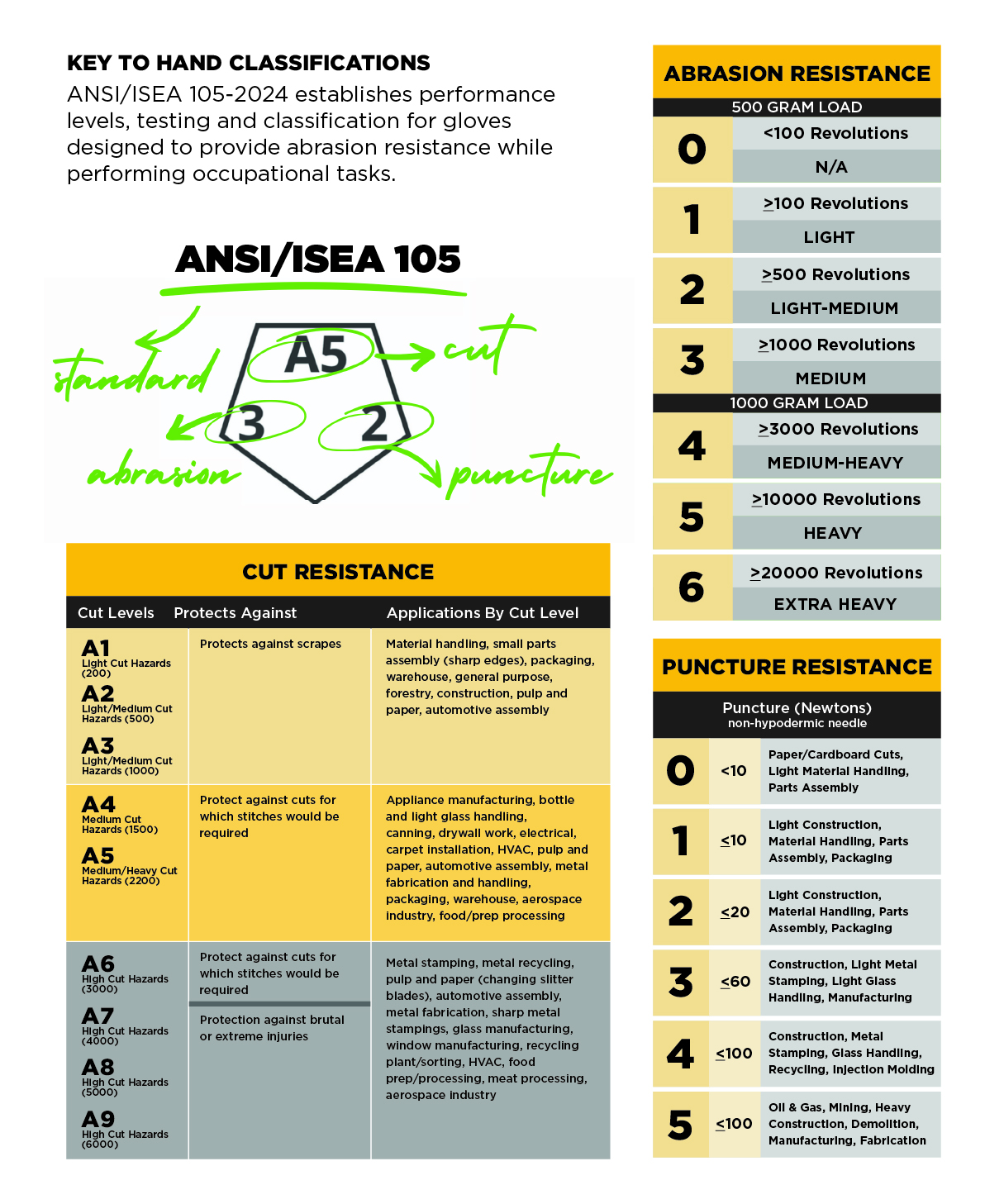
A glove built for one hazard doesn’t automatically cover another. A heavy cut-resistant liner can still let a splinter through if the puncture rating is low, and a thick abrasion-resistant palm won’t necessarily stop a blade. If your job touches more than one kind of hazard, check more than one rating. The symbols are usually printed on the glove or its packaging.
Does a higher cut level always win?
No. A higher cut level means the material resisted more force in a lab, not that it’s the right glove for your hands.
Thicker, more cut-resistant materials can cost you dexterity, flexibility and feel. Picture assembling small parts in a glove built for scrap metal. You lose grip, you lose dexterity, and the glove ends up back in the truck instead of on your hands. The goal isn’t the biggest number on the rating. It’s enough protection for the hazard, in a glove you’ll actually keep wearing.
How to choose a cut level for your job
Start with what your hands actually touch, not the general name of the material.
For packaging, general handling, and basic warehouse work, A1 through A3 usually covers it. Move into drywall, HVAC, electrical work, or light glass and metal handling, and A4 or A5 is where most jobs land. Metal stamping, sharp scrap, and glass manufacturing call for A6 through A9.
From there, look past the cut number. Do you need grip in wet or oily conditions? Are you also facing puncture or abrasion risks? How long are you wearing gloves in a shift? Our glove terminology guide walks through the other terms you’ll run into while comparing gloves, and our materials guide covers how different fibers, leathers, and coatings change the way a glove performs. Most importantly, our glove fit guide ensures the optimal fit and performance of your selected pair.
Find the right cut level for the job
A cut rating doesn’t need to read like alphabet soup once you know what it means. Start with the hazard, check the rating, then pick a well-fitting glove that protects your hands without getting in the way of the work. Wells Lamont makes cut-resistant gloves at more than one level, so you can match the glove to the work.
Our Men’s FX3® PU Coated Grip Gloves carry the A4 rating we walked through above, for drywall, electrical, and light metal and glass handling. For parts with mildly sharp edges or light construction, the Men’s Latex Coated Cut Resistant Knit Wrist Gloves step down to an A3 shell.
Wells Lamont has made hard-working gloves for hard-working people since 1907, and matching the right rating to the right hazard is still the whole idea. Browse more Wells Lamont cut-resistant gloves built for the work in front of you.